Coming Of Age On The High Plains — Mid‑Century Memories
Chapter Thirty‑Two
Crabapples And
Cruising Main
Timber Lake, South Dakota — 1957
Pastorale — composed and performed by the author
ICruising
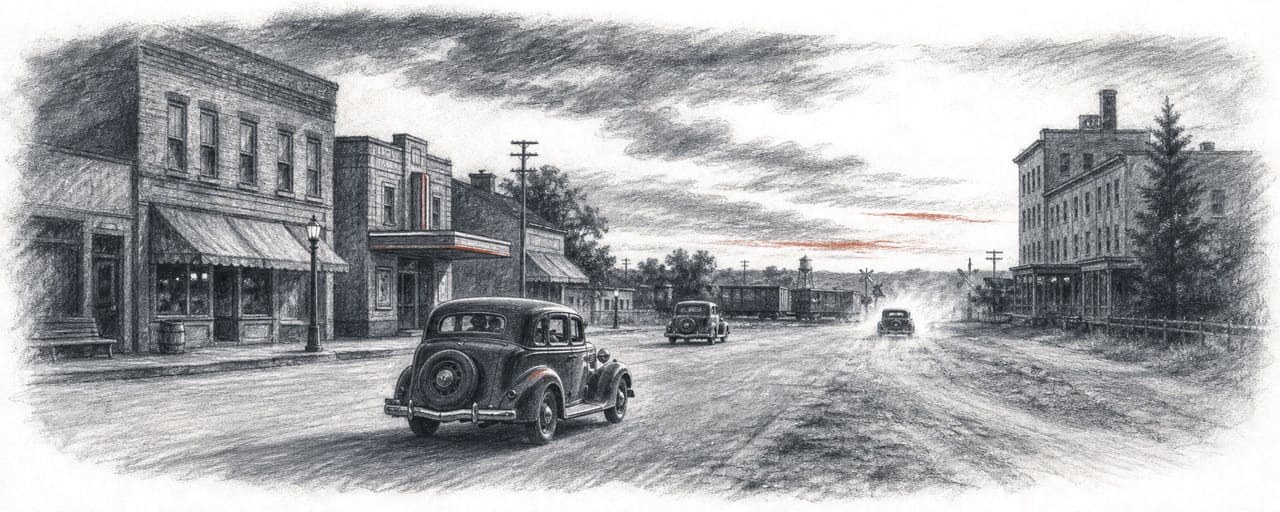
Timber Lake’s Main Street was an half-mile long. It commenced at the wye at the south end of the lake and ended near the boundary of the Cheyenne Indian Reservation at the very south end of town. There was a very convenient dead-end street off Main and directly north of the Masonic Temple where one could make an U-turn. And on the south end of Main one could turn around between the Scott house on Main’s east side and the McMacken house directly opposite on the west. Those members of the Junior class (my sister, Jean’s class) in 1957 were of the age when one could obtain a driver’s license. Many young men purchased 1938 and 1939 Plymouths, Fords and Chevy’s which were available in good running order and at a cheap price. Each young owner personalized these sedans with add-ons.
The young men (I don’t believe there were any ladies of Jean’s class who owned a car) might attach to the steering wheel a turning knob in gaudy Bakelite. Or they hanged a pair of fuzzy dice from the center windshield mirror. Or they attached a chrome-plated spotlight to the outside of the left windshield mount (with an attached rod above the dash on the inside for adjustments). Or a side-mounted round chrome-backed mirror might be affixed to the driver’s door. Or they placed chrome trim plates to the visor and the license-plate surround if it was a Chevrolet Master Deluxe Coupe. Another good add-on were large fog lights each of which sat on either side of the grill and below the bullet-shaped headlamps—fog might occur once a decade, but fog lights made a good show. Both the ’38 Ford and Plymouth sedan had suicide doors and top-mounted windshield wipers. All had divided windshields and running boards.
Many young men from both Firesteel and Isabel to the west (some ten and twenty miles distant, respectively) and Glencross and Trail City to the east (some eight and twenty miles distant, respectively) came to cruise and to Main on both Friday and Saturday evenings in the late spring, summer and early fall. These four villages had no cruising streets. And whatever James Dean did, so did they ape him with side-ways glances, rolled-up pant legs and curled pompadours. These gladiators who owned these chariots rarely arrived alone but with one-to-four passengers, young ladies in gray poodle skirts and bangs. Their clothing was a much an uniform as anything the armed forces used; they were sartorially resplendent, weren’t they? Cruising usually occurred before the 8:00 P.M. movie at the Orpheum Theater and after it from 9:30 to 11:00. On a good night, some dozen polished chariots moved slowly up-and-down Main Street from the north U-turn to the south turn-around.
With the windows rolled down, the radio blaring, each gladiator moved along the street in second gear—any faster than fifteen miles-an-hour resulted in a dust storm rising from the dirty street (only the three-block business section was paved). These were moving targets and fabulous lobbing opportunities for we pre-teenagers and as irresistible as were droppings on parked cars to a pair of nesting storks. Resistance to this temptation was impossible.
IIThe Lob
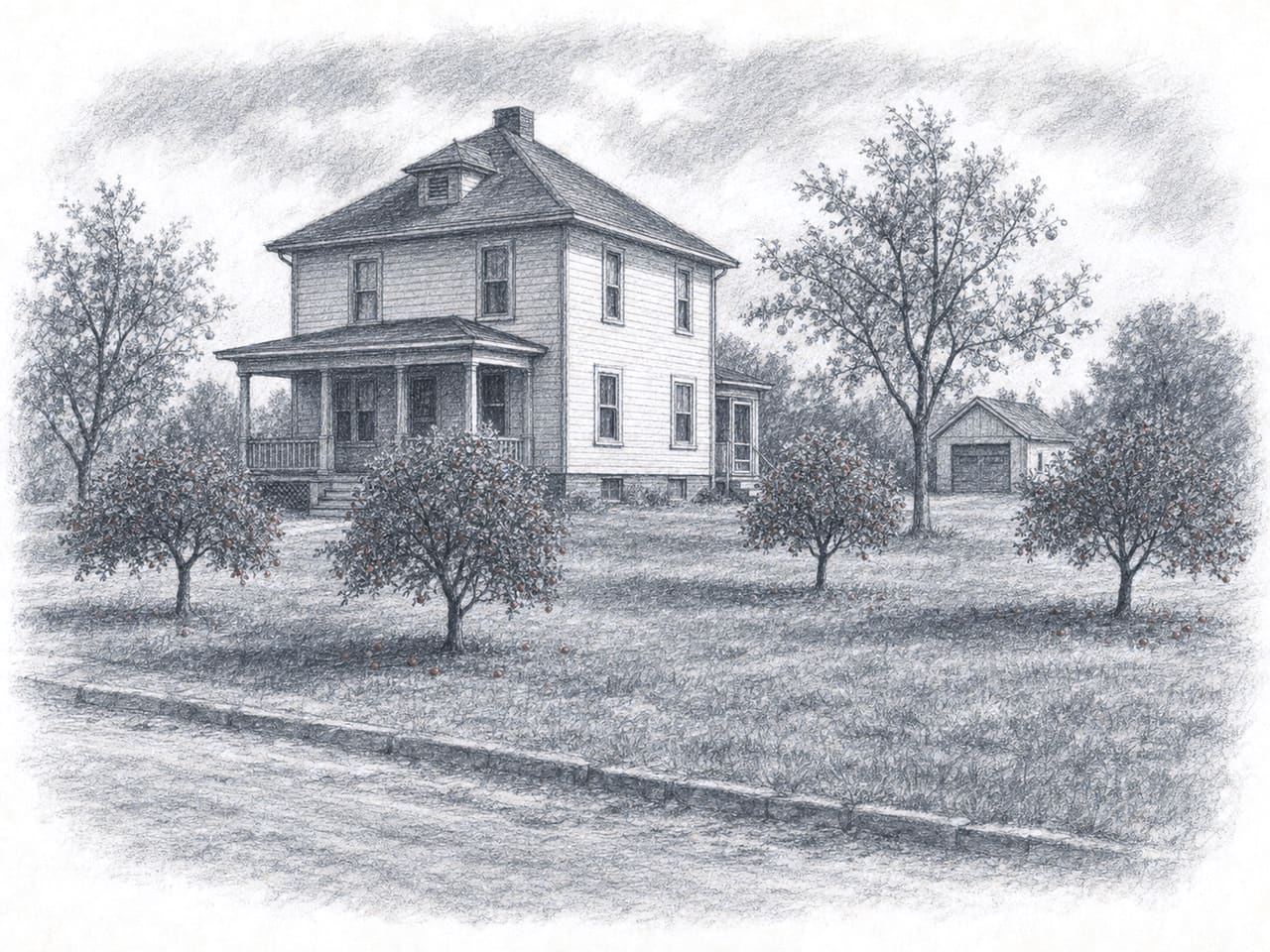
Across the street and two houses south of ours was the grand house of Doc McClellen, Timber Lake’s excellent dentist. He had a double lot in the middle of the block. His home was the only full two-story house in town. It had a front porch along the west front entrance, a back kitchen porch and a detached garage at the rear. And he had an orchard—two apple trees and four crab-apple trees. A fully grown apple could cause real damage when lobbed at a car. But a crabapple—not so much. Lobbing a crabapple and making direct contact with a car’s roof, hood, windshield or trunk made a resonant and compelling thump. Ah, crabapples. Quick. Up over the hedge. A thud. The drive-way exit.
This apple-pelting was a direct affront to any gladiator’s ego. Thump. Thump. Thump. Someone was mocking his chariot, his joy, his pride, and it resonated with his passengers. This was no less an affront than it was an outrage. It would not, simply could not, stand. Even more delicious was contact from an over-ripe crabapple, the result of which was tart, messy and a pasty splat.
There were four-or-five of us in my class who gathered but for a short time each Friday and Saturday evening to mock motor vehicles. And the house next door to ours was perfect for crabapple lobbing. Stoick’s house sat in the middle of our block on two lots. The story-and-an-half house occupied the middle of the north half with a well-tended small patch of grass west of the front-porch. A driveway divided the lot from front to back, exiting in the alley. A rear detached garage/chicken-coup was in the back south half of the lot. But the front south of the lot was lobbing perfection.
Next to Main Street on the lot’s south half was a six-foot high, foot deep, beautifully trimmed and dense Chinese Elm hedge. Between this hedge and a short white picket fence was a strip of dirt where a city sidewalk could have been. Gathering behind the south end of the hedge next to our driveway off Main provided us an opportunity to view the passing of a gladiator in his chariot in front of the school and our house with just enough distance beyond we lobbers for good aim and yet with enough time to make a quick exit. We had to time our lobbing so that there was no vehicle coming towards us, just proceeding past us going south. We’d each lob one-or-two quick volleys of crabapples, listen for a thud and then run north between the hedge and the picket fence and east down Stoick’s driveway to the hiding places in the alley. It was great fun. We never got caught. Those gladiators—they be stupid.
Friday evening. You’re crouched behind the hedge with a crabapple in your hand, and the chariots keep coming. You have to lead them a little.
Once pelted, there were several volleys of cuss words these gladiators hurled at us—words suggesting cowardice, our inadequate manhood (they were confident that young ladies were not involved with this activity), our lousy aim. And there were threats of laying hands upon us, threats of the rearrangement of our facial features, threats of our need of crutches were they to catch us, threats of being tied and drug behind their cars—all bravado on the gladiators’ parts as they were in reality protesting their inability to discover who was lobbing at them and their inadequacy in catching us. Any gladiator worth his salt would have placed two-or-three of their ilk at the northeast side of the school, and in the dark, to apprehend us. But their dullness was exceeded only by their lack of imagination and planning.
IIIThe Reckoning
Then Dad decided to walk downtown, Saturday morning, to get the mail. Funny how something so incidental may indeed lead to accountability, embarrassment, culpability and moral lessons hard learned.
Transcript of Proceedings
in the matter of thirty‑to‑forty crabapples · Saturday morning
(Dad came into my bedroom and sat upon the sofa while I was at my desk.)
Q.Now, I’ve got some questions for you, (using a tone with just a glimpse of a rapping gavel to it) I just got the mail and on my way across Main, I noticed thirty-to-forty crabapples scattered all over the street in front of the house. (Looking me searingly in the eye) What can you tell me about those crabapples?
A.Oh, (with a gulp) Well, I suppose someone threw them there.
Q.And who might that ‘someone’ have been?
A.Well, some of my friends. And me.
Q.How many friends?
A.Four.
Q.So, what were you doing with crabapples?
A.We’d lob them at passing cars.
Q.Which passing cars?
A.Well, those young guys cruising Main on Fridays and Saturdays.
Q.You mean you have lobbed them before last night?
A.Yah. I guess so. But only the last month or so.
Q.ʽOnly the last month or so,’ you say. Hmmm. Why only at those cruising Main?
A.Their cars are always shiny and waxed. They made good targets, I guess. Especially when the crabapples are mushy.
Q.You and your friends decided that pelting cars was a productive activity, did you?
A.Not so much productive as kind of fun, I guess.
Q.Fun, you say. Was it fun for the car drivers to be pelted with crabapples?
A.Probably not so much. They did some yelling at us.
Q.I would say that you and your friends are fortunate indeed that they didn’t just jump out of their vehicles and give you a good pounding.
(I lowered my head at this point.)
(He continued.)
Q.So just how did you come by these crabapples?
A.Oh. We found them at Doc McClellan’s orchard.
Q.You ‘found’ them, you say. Explain to me what you mean by ‘found.’
A.Well, they were hanging on his trees, mostly. And some from the ground.
Q.You picked them from the trees, did you?
A.Only the first and second weekend we lobbed them. After that, they were lying on the ground.
Q.Which one of you and your friends went up to his door and asked his permission to pick the apples?
A.I guess we didn’t get his permission. Not really.
Q.Tell me: What is the Eighth Commandment?
A.Thou shalt not steal.
Q.Just what does it mean, to steal?
A.It means to take something that isn’t yours.
Q.You knew what the Commandment said. You knew what it meant. And yet you stole from Doc McClellan, regardless.
A.Well, not so much stole them as took what was lying on the ground.
Q.You said you picked them from his trees the first and second week, didn’t you?
A.Yes.
Q.So, you stole from Doc McClellan. How can he make crabapple jelly from apples lying in the street?
A.I guess he can’t.
Q.How can he make use of the fruit from his own trees when they disappear before they have a chance to ripen?
A.I guess he can’t.
Q.How much money have you in your checking account?
A.Around $50.00 or so.
Q.Now, here’s what you’re going to do on Monday morning. You’re going down to the bank and withdraw $10.00 from your account. Then you’re going to his house—he’s retired and should be home. You’ll go to the door and you’ll do three things. One—you apologize for your theft. Two—you offer him the ten dollars or, Three—you give him the choice of you working in his yard for eight hours as payment for what you stole. You are to use the word ‘steal,’ ‘stole,’ or ‘stolen’ when you apologize. Then you will report to me Monday after I come home from the office of what you said and what he said. Is that understood?
A.Yes sir.
He stood. He looked at me. His disgust was a moldy mask upon his face. His eyes saw disappointment. His mouth was turned down and resting upon sadness. He left the room with no shadow but sorrow trailing him.
It was a long weekend. It was a weekend filled with dread and shame. It was a weekend contemplating corruption, sin, guilt and dishonor (to not only me but to my father and the family).
IVDoc McClellan
to come
At 10:00 on Monday, I walked across the street to the south of our house, down the alley and up to McClellan’s back door. I could hear both the doorbell chime and footsteps from the kitchen. “Yes?” Doc asked. “Sir, I’m Tom Taggart. Friday evening, I stole some of your crabapples and I want to make it right with you, if I may.” Doc opened the wood screen door with a squeak and stepped out unto the landing. “You took some crabapples? Just you?” “Well, no. I took some and some of my friends did, too.” “How many friends?” he asked. “Oh, I guess three friends.” He knit his brow and asked, “Well, where are those three friends? Why aren’t they here with you?” “I don’t know, sir. It’s just me,” I said.” “And what do you mean, ‘make it right’?” “Well, I took what didn’t belong to me and that’s breaking the eighth commandment. So, here’s ten dollars to pay for the crabapples. Or I would be willing to report here and do any work you wanted for a day as payment for what I stole.” “Hmm,” he hummed. He looked down in thought at the landing’s wood boards and then disappeared into the kitchen.
Doc returned immediately with a big paper bag. “Let’s go to the crabapples,” he said, as we stepped down the steps. While he performed any dental work on us, all in our family noted that he whistled very softly through his teeth whenever we sat in his dental chair. And he was whistling as we approached the crabapple trees. “Here. You hold the bag and I’ll fill it with tender, ripe apples. They’re the best. They make the best jelly, I think. I’ve got a really simple recipe I’ll send over later this afternoon so your mom can cook ‘em. They make a tart and tasty spread, especially on toast.” We filled the sack and then he turned to me.
“It takes no little courage and humility,” he said, “to come over here and admit your mistake. I really appreciate what you’ve said. Now, I won’t repeat a word to anyone about what you stole. Your apology is more than enough to ‘make it right,’ don’t you think?” I was astonished and replied with a quiet voice, “Yes sir. And thank you, sir. And thanks for the crabapples. Mom will really enjoy them. Thank you, sir.” “You head on home now and have a good day. I’ll be over later with the recipe.” He placed the bag in my left hand and shook my right hand. Then he turned towards his house, whistling softly through his teeth.
Yet the initial wonder of it was that, not only did Doc McClellan accept my apology, he refused both the money and my offer to work for him. But the wonderment was more. Far, far more. His mercy towards me was like Joseph’s to his ten brothers. His forgiveness of my theft was like Esau’s of Jacob’s. His lack of condemnation of my character was like David’s to Saul’s. His compassion for my wastefulness was like the father to the prodigal. His application of justice was like Christ’s response to Peter’s three-fold betrayal. In all, the experience was the soaring sound sweetly sent from Mozart’s Laudate Dominum to wash my mind of this sin, to cleanse my heart of its stench and to nourish with God’s pure love my soul. Had I not a just and righteous father, but vastly more importantly, the learned knowledge of God’s righteousness and justice, this crabapple caper would not have exposed the wondrous mid-century luster of the high plains during which I came of age.